

Today’s homes and businesses rely on a stable internet connection more than ever. Whether you’re working remotely, streaming 4K video, managing smart home devices, or running cloud-based business applications, losing internet access can bring everything to a halt.
One solution is to use multiple internet providers with a multi-WAN router. But once you start researching these systems, you’ll likely come across two terms: load balancing and bonding.
While they sound similar, they solve different problems. Understanding the difference can help you choose the right networking solution.
What Is Load Balancing?
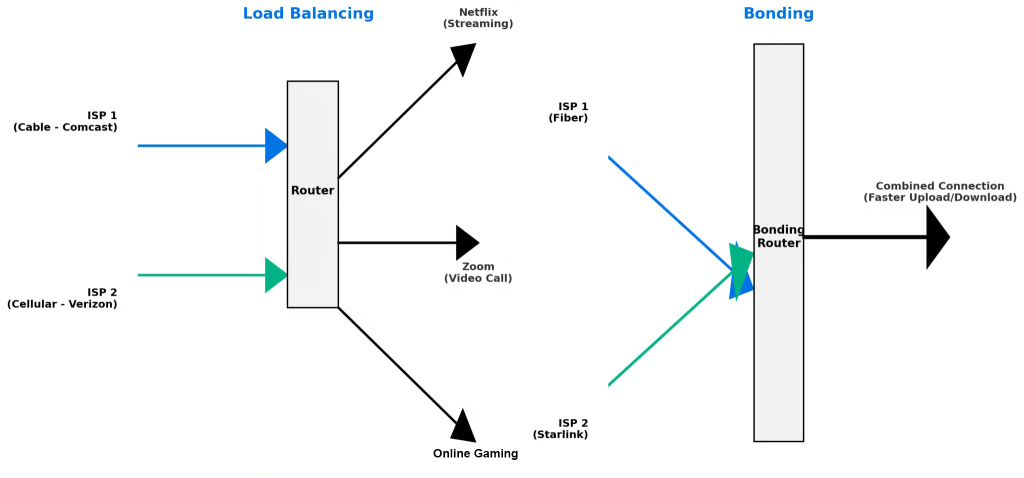
Load balancing distributes internet traffic across two or more internet connections instead of relying on a single provider.
For example, you might have:
- Xfinity Cable Internet
- Starlink
- Verizon 5G Home Internet
A load-balancing router intelligently decides which connection should handle each new internet session.
One person streaming Netflix might use your cable connection while someone else is on a Zoom meeting through your 5G connection. If one internet provider experiences an outage, traffic can automatically shift to another available connection.
Benefits of Load Balancing
- Better overall network performance
- Prevents one connection from becoming overloaded
- Automatic internet failover
- Increased reliability for homes and businesses
- Makes better use of multiple ISPs
What Load Balancing Doesn’t Do
A common misconception is that load balancing combines internet speeds.
If you have a 500 Mbps fiber connection and a 300 Mbps cable connection, a single download will not reach 800 Mbps. Each individual session still uses only one internet connection.
Instead, the total bandwidth is shared more efficiently across all users and devices.
What Is Internet Bonding?
Bonding takes things a step further.
Instead of assigning each session to a different internet connection, bonding combines multiple internet services into one virtual connection.
The router splits data into smaller pieces, sends those pieces across multiple internet providers simultaneously, and then reassembles everything before it reaches its destination.
This process typically requires specialized hardware and a cloud-based bonding service.
Benefits of Bonding
Bonding is ideal when you need:
- Faster uploads
- Higher download throughput
- Maximum uptime
- Seamless failover without interrupting active sessions
- Improved performance for video conferencing and live streaming
Unlike traditional load balancing, bonding can improve the performance of a single large upload or download because multiple internet connections are working together.
Load Balancing vs. Bonding: Quick Comparison
| Feature | Load Balancing | Bonding |
|---|---|---|
| Uses multiple internet providers | ✔ | ✔ |
| Improves network reliability | ✔ | ✔ |
| Automatic failover | ✔ | ✔ |
| Combines bandwidth for one download | ✘ | ✔ |
| Best for everyday internet use | ✔ | ✔ |
| Best for video production and livestreaming | Limited | ✔ |
| Requires additional bonding service | No | Usually |
Which Option Is Best?
Load Balancing Is a Great Choice If:
- You want reliable internet with automatic failover.
- Your home has many connected devices.
- Your office depends on cloud applications.
- You use security cameras that must stay online.
- You want better performance without paying for enterprise networking.
Bonding Is Worth Considering If:
- You frequently upload massive files.
- Your business hosts webinars or livestreams.
- You rely on uninterrupted VoIP phone systems.
- Every second of downtime costs money.
- You need the highest possible internet reliability.
Real-World Example
Imagine a business has:
- Fiber internet
- Starlink backup
- Verizon 5G
With load balancing, employees can be spread across all three connections, reducing congestion while providing automatic backup if one provider fails.
With bonding, those three internet services work together to create one highly resilient connection that can maintain video calls, cloud applications, and file transfers even if one provider suddenly drops offline.
Why Multi-WAN Networking Matters
Internet outages happen—even with the most reliable providers.
For businesses, downtime can interrupt customer service, payment processing, security monitoring, and remote work. For homeowners, it can mean losing access to smart home devices, streaming services, or connected security systems.
We live in Southwest Florida, and our roads flood with heavy rain, our City’s current “internet” infrastructure is underwater, and fails in those times, as a Secondary Internet connection we strongly recommend Starlink.
A professionally designed multi-WAN network helps keep you connected by providing redundancy and intelligent traffic management.
Let CounterStrike Build the Right Solution
At CounterStrike Security & Sound, we design networking solutions that keep homes and businesses connected when reliability matters most.
Whether you’re looking for automatic internet failover, improved network performance, or a fully redundant multi-WAN solution, our team can recommend and install the right equipment for your needs.
Contact CounterStrike Security & Sound today to learn how a professionally designed networking solution can deliver faster, more reliable internet for your home or business.